Terminating the Termites: A story of urban resilience
- Marjita Mahanta

- Aug 5, 2025
- 4 min read
“While we have been trying to save the world’s crumbling pre-urban ecosystem, we have been ignoring the fact that nature has already been putting up the scaffolds to build novel, urban ecosystems for the future.”
-Menno Schilthuizen, Darwin Comes to Town (2018)
More than half the world’s population now lives in cities. But cities aren’t just made of buildings and roads. They’re full of life—plants growing through cracks in the pavement, birds nesting in traffic circles, and insects making their homes behind our cupboards. Among these urban survivors is one creature I’ve come to fear and admire: the termite.
Termites are usually bad news. They eat wood and paper, and can destroy shelves, furniture, and important documents. A 2005 study estimated that termites cause about $50 billion in damage worldwide every year. I first met them up close in a small PG room in north Delhi.
Along with the bright red Gulmohar, the dawn of spring in Delhi saw the coming in of tiny termite houses in the crevices of our room wall. Fast forward to June, they had become a “nuisance”, with the cleaning staff having given up, from trying everything – from scraping their build-ups manually to spraying strong, pungent, anti-termite sprays.


In my half-serious analogy, the termites have become the colonizers of pre-independent India, staking claim to the wooden shelves, annexing the bed box, and waging silent campaigns deep into the wardrobes.
However, despite varying and repeated attempts, the termites seem to be winning. So much so that it prompted me to embark on a journalistic journey to highlight their resilience, something lesser talked about in the media.
Ancient Architects
Termites have been around for millions of years—even when dinosaurs roamed the Earth. They’re one of the earliest known social insects, living in large colonies with a king, queen, workers, and soldiers. Some termites live inside wood, others go out to find food. Their teamwork and division of roles are surprisingly complex—some even delay growing up to help the colony, hoping one day to take over as breeders.
Despite their bad reputation, most termite species don’t damage homes. In fact, they play a key role in nature. They break down dead plants and turn them into rich soil. In tropical forests, termites can make up almost 95% of the insect life in the soil. Their huge mud mounds—sometimes taller than a person—help keep the soil healthy and support other life, even after the termites have left.

Evolution in the City
Urban ecologist Menno Schilthuizen argues that cities are not just places where nature disappears—but where it evolves. Birds in Mexico City, for example, have started using cigarette butts in their nests to keep bugs away. Snails in European cities are changing color to cope with the urban heat.
Termites, too, are adapting. They’re learning to survive in buildings made of new materials, thriving in the warm, closed spaces of our homes, and possibly becoming resistant to our chemicals. We keep inventing new ways to kill them; they keep finding ways to survive. It’s a silent tug-of-war, and both sides are evolving.
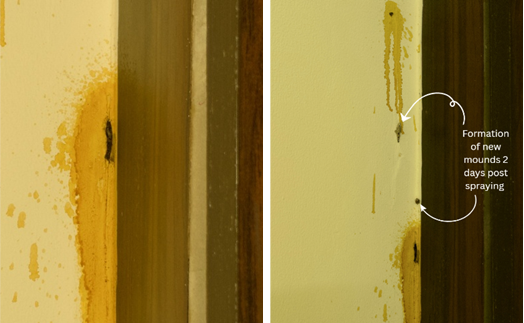
In this way, termites show us that cities are not as controlled as we think. We may build and plan them, but other species are constantly improvising and reshaping them. Termites, though tiny, remind us that nature is alive and active in our cities—even if it sometimes costs us a shelf or two.

Postscript from the PG
It’s mid-July as I conclude this blog. The room has been vacated, a termite termination operation carried out, repainted, and declared termite-free. But perhaps, in their hidden tunnels, they are already regrouping and reworking their secret blueprints.
In that sense, they become unlikely teachers—about resilience, about the folly of imagining the urban as purely human. Cities are never fully settled; they are alive, ever-changing, and full of negotiations—even by the tiniest social insects building silent empires behind our wardrobes.
(This story is a simplified adaptation of a blog post originally published by the Centre for Urban Ecology and Sustainability and can be accessed here.)
About the author:
Marjita Mahanta is a recent postgraduate in Environment and Development, with a deep interest in political ecology, sustainability, urban nature, and ecological restoration. She critically engages with the impacts of consumerism and capitalist excess, and holds a firm hope for justice and freedom in the world, including a free Palestine.


Comments